One of Melbourne's most loved LGBTQIA+ celebrations, Midsumma Festival 2026 ran from 18 January to 8 February 2026. The vibrant three-week party featured more than 250 events spanning art, theatre, music, comedy and film, and showcased the best of local and international queer talent. Guided by the theme Time & Place, the festival centred on community, with art exhibitions, inspiring conversations, and free outdoor celebrations delivering an uplifting experience across the city.
Signature events anchored the calendar, including the Midsumma Carnival, Midsumma Pride March, and the Victoria's Pride Street Party. Unfolding across 22 days in over 100 venues across Melbourne and regional Victoria, the festival was celebrated as a fabulous showcase of queer arts, creativity, courage, and community.
Midsumma engaged Culture Counts to evaluate its 2026 festival. Surveys were distributed via interviews by Midsumma volunteers across Midsumma Festival events, as well as an open link to the online survey via the Midsumma website and e-newsletter.
In total, 1,636 members of the public were surveyed through interviews and online surveys, including 649 responses from those surveyed as part of Victoria's Pride 2026 and 968 from Midsumma Festival 2026. Unless otherwise stated, the findings in this evaluation showcase the aggregated results for both surveys.
Each survey contained a range of ‘dimension’ questions, asking attendees and participants about their experience of the festival. These dimensions have been developed and tested in collaboration with industry, practitioners and academics to measure the impact and value of arts and cultural events and activities.
Appropriate dimensions were chosen based on their alignment with Midsumma Festival's strategic objectives.
| Domain | Dimension | Dimension Statement |
|---|---|---|
| Cultural | Meaning | It moved and inspired me |
| Social | Connection | It helped me to feel connected to people in the community |
| Safe | It made me feel safe and welcome | |
| Wellbeing | It had a positive impact on my physical health and mental wellbeing | |
| Qualities | Local Impact | It's important that it's happening here |
Dimensions are assessed on a Likert scale, in which respondents move a slider to a point that indicates whether they agree or disagree with the dimension statement. An example of a dimension question in the Culture Counts survey tool is presented below.

Survey participants were asked to provide their gender and ages at the end of the survey. This enables the event organisers, Midsumma, to understand the demographic mix of its audiences, identifying whether particular groups are more likely to attend festival events and whether they are impacted differently by their experience. This knowledge can facilitate targeted marketing in future years.
Respondents were also asked about the ages of the children attending the festival with them. These proportions have been added to the age chart below.
Male and female respondents comprised roughly equal parts of the sample, with 45% identifying as male, and 40% as female. Respondents who identified as non-binary made up 8% while those identifying as transgender comprised 4% of the sample.
The largest percentage of respondents was aged 25–34 (30%) followed by 28% aged 35–44. 7% were under 24 years of age, and 18% were 55 years or over.
Of the children attending with survey respondents, less than 1% was reported for each of the following groups: children aged between 12–17 years and 5–11 years.
Survey respondents were asked to provide information regarding their diversity and sexual identity. This helps event organisers to understand engagement and experience for different groups.
Survey participants were most likely to identify as autistic/neurodiverse (25%), a person living with a mental health issue (21%), or as culturally diverse or a person of colour (19%). 13% identified as a person living with chronic illness and/or chronic pain, 11% as a person living with a disability and 5% of respondents indicated they were a carer for someone with a disability.
4% preferred not to disclose their identity, while 41% of respondents did not identify with any of the provided options.
Regarding sexual orientation, just over one-third (38%) of Midsumma Festival 2026 survey respondents identified as gay, followed by lesbian (14%), queer (12%) and heterosexual (12%).
91% indicated that they do not have an intersex variation, while 5% did not know and 3% preferred not to say. Only 2% reported having an intersex variation, with less than 1% selecting other.
Survey respondents were asked to provide their current living location and postcode. This data identifies the geographic sample of people who responded to the survey and took part in the diverse array of events at Midsumma Festival 2026.
The following charts show the proportion of survey responses captured for respondents' identified living location and top ten postcodes reported.
Respondents were most likely to reside in the Melbourne metropolitan area (85%). 10% were based elsewhere in Victoria and 3% were based interstate. 2% of respondents were visiting from overseas.
The top 10 postcodes were located within the inner and middle ring suburbs of Melbourne. The most commonly cited postcode was Collingwood (4%), followed by Fitzroy, Northcote, Melbourne, Richmond and St Kilda.
Respondents were asked about their household structure and combined household income. The distribution of results can be seen in the charts below.
The largest groups represented in the household structure were couples and singles, with couples making up 38% and singles accounting for 32%, together comprising 70% of the sample. 16% of respondents reported living with family, while 14% lived in a share house.
50% of respondents indicated that their combined household income exceeded $100,000. This was followed by 12% who reported incomes between $80,000–$100,000, and 12% who preferred not to disclose their income.
Respondents were asked who they attended Midsumma Festival 2026 with, if they attended with children, and the ages of those children. The results are displayed in the charts below.
Over half of the sample attended the 2026 festival with friends (58%), while 23% went with their partners. 13% travelled solo to the festival and 4% attended with family.
Of the respondents who attended with children, just under half (49%) visited the festival with children under 4 years, 38% with children aged 5-11, and 35% with teenagers over 12 years old.
Respondents were asked about which events they attended as part of the festival, how many events they attended and whether they had attended Midsumma Festival before. The results from these questions are displayed in the charts below.
Close to three-quarters (71%) of survey participants indicated that they attended Midsumma Festival previously, while the remaining 29% were first-time attendees. This demonstrates the festival's ability to retain existing audience members while also attracting new ones.
The most popular festival events were the Midsumma Carnival (68%), performance events (46%) Victoria's Pride Street Party (41%) and the Midsumma Pride March (39%). The least commonly cited options were 'Youth event/s' (2%) and 'Faith event/s' (<1%).
Attendees went to 2.9 events on average across the 2026 festival, on par with 2025. The majority of respondents reported attending 3–5 events (35%), followed by one event (27%), two events (26%) and 6–9 events (7%).
Survey respondents moved a slider to indicate whether they agreed or disagreed with the dimension statement using a Likert scale. The chart contains data for all survey responses, showing the average score and the percentage of people who agreed or disagreed with each of the statements across the festival evaluation as a whole.
The accompanying Margin of Error chart provides an overview of the confidence level or overall accuracy of data collected, in relation to the number of survey responses gathered (sample size).
'Local Impact' (93/100) and 'Safe' (90/100) recorded the highest averages of the five dimensions measured. These results indicate that respondents were most likely to find the festival important for Melbourne and feel safe and welcome while attending. 'Connection' (86/100) also scored highly, demonstrating that attendees felt connected to people in the community as a result of the festival.
At a 95% confidence level, the margin of error for dimensions ranged from 0.8% to 1.1%. This means that we can be 95% confident that if the entire audience population were surveyed, the average score for 'Meaning' would fall within 1.1% of the average generated by the sample. This indicates strong significance and highly representative results.
Survey respondents moved a slider to indicate whether they agreed or disagreed with the dimension statement using a Likert scale. The chart contains data for all Midsumma and Victoria's Pride responses, showing the average score and the percentage of people that agreed or disagreed with each of the statements across the festival as a whole.
All five dimensions recorded high levels of agreement, with scores of 89% or higher. Both 'Local Impact' and 'Safe' recorded the highest agreement scores of 97% and 96% respectively, indicating that the majority of survey respondents agreed that the festival was important for Melbourne and made them feel safe and welcome. 'Connection' and 'Wellbeing' also recorded agreement levels of 90% and above.
Respondents were asked about their overall experience of attending Midsumma Festival 2026, with a choice of five options - Excellent, Good, Neutral, Poor and Terrible.
The vast majority (95%) reported having a positive overall experience at Midsumma Festival. Of this, 72% had an excellent experience and 23% had a good experience. 3% of respondents reported having a neutral experience and less than 2% reported their experience as poor or terrible.
Results can be filtered by demographics and custom questions to see whether particular groups within the Midsumma Festival 2026 audience experienced the festival in different or more impactful ways.
The following charts distribute the average dimension scores given by the age and gender cohort that respondents identified with.
Survey respondents who identified as female reported the highest average scores for three of the five dimensions, including 'Safe' (92/100), 'Wellbeing' (86/100) and 'Meaning' (84/100). Agender/no gender respondents scored highest for 'Local Impact' (97/100) and 'Connection' (91/100).
'Wellbeing' showed the most consistent agreement across age groups (apart from those aged 4 and under), suggesting that the physical health and mental wellbeing benefits of the festival were not influenced by age. The sample of respondents under 18 years was too small to draw valid conclusions. Outside of this group, respondents aged 25-34 recorded the highest average scores for four of the five dimensions. Results for 'Local Impact' decreased slightly by age, with younger respondents recording higher averages.
The following charts pivot the average dimension results by identity.
Among all the dimensions measured, 'Local Impact' exhibited the highest and most consistent results across all identity groups, with scores of 90/100 or above. This indicates that attendees were likely to agree about the importance of the event for the local area, regardless of identity.
There were not enough responses from attendees identifying as Deaf to draw accurate comparisons, however respondents identifying as hard of hearing recorded the lowest average scores for three of the five dimensions. Participants who identified as blind/low-vision recorded the highest average scores for four of the five dimensions.
When examining results based on sexual identity, respondents who identified as asexual recorded the lowest averages for all five dimensions. There were no significant differences amongst other sexual identities, with the most consistent results for 'Local Impact'.
The following charts pivot the average dimension results by the living location of respondents.
Respondents living locally in metro Melbourne or other parts of Victoria were most likely to feel connected to others as a result of the festival ('Connection'). Respondents from other parts of the state recorded the highest or equal highest average scores for four of the five dimensions, including a signficantly higher score for 'Meaning'. Interestingly, respondents from interstate found the festival most important for the local area.
Dimensions used in the Midsumma Festival 2026 evaluation were also measured every year since 2018. This allows organisers to benchmark their results and track progress in achieving strategic outcomes over time. The following chart compares the results for previous years.
Results for 2026 exceeded or were equal to 2025 results for three of the five dimensions. 'Connection' increased by 2/100, and 'Wellbeing' increased by 1/100 from 2025, indicating ongoing improvement in feelings of community connection and health and wellbeing associated with the festival. 'Local Impact' remained the same with a high average of 93/100. 'Meaning' fell slightly (by 1/100), while 'Safe' fell by 2/100, however still recorded a strong average score of 90/100.
Culture Counts encourages the use of consistent demographics across evaluations, allowing results to be compared over time. The charts below show the gender and age breakdowns by year since 2018.
The 2026 festival saw a slight increase in respondents aged 25-34 (+3%) and 35-44 (+4%), accompanied by a slight decrease in respondents aged 55-64 (-5%) and 65 and over (-2%).
2026 saw a 1% increase in non-binary and transgender respondents from 2025. Male respondents also increased slightly (+3%) while female respondents fell by 5%.
The charts below compare results for diversity and sexual identity at Midsumma Festival by year from 2018.
The percentage of respondents identifying as autistic/neurodiverse increased significantly in 2026, to 25%. Respondents living with chronic illness also increased slightly to 13%. Respondents living with disability remained consistent with 2024 and 2025 results (11%), as did the percentage of culturally diverse respondents (19%).
The percentage of respondents identifying as gay rose slightly from 2025 (up 4% to 38%), while those identifying as heterosexual dropped significantly from 20% in 2025 to 12% in 2026. The percentage of respondents identifying as bisexual has remained consistent since 2023 (11%), while those identifying as pansexual increased slightly in 2026 to 6%.
Respondents were asked how they heard about Midsumma Festival 2026, in order to evaluate the success of various marketing methods. 13 options were provided and respondents could choose as many options as were applicable from a list.
The largest percentage of respondents (45%) learned about the Midsumma Festival 2026 through social media. This was followed by 'someone told me about it' (34%) and the Midsumma program guide (27%). 15% of respondents indicated that they've always attended the festival, while 11% saw an outdoor ad and 10% discovered the event via the Midsumma eNews. The least common marketing channels were Google/online ads (3%), radio (3%), and blogs (less than 1%). Many respondents who selected ‘other’ reported hearing about the festival through recommendations from friends, colleagues, or artists they follow who were performing at the festival.
Survey respondents were asked if they could recall the supporters and partners of Midsumma Festival 2026. Respondents were asked to list the organisations they could recall, first by typing in the name of the organisation without prompting, and then again from a multiple-choice list.
The following charts detail the sponsor and brand awareness and recall for the event.
Almost three quarters of survey respondents (74%, up from 72% in 2025) recalled noticing sponsors of Midsumma Festival 2026.
When asked to name the event sponsors without prompting, NAB was the most commonly recalled event partner, mentioned by 21% of respondents (same as 2025). This was followed by the City of Melbourne at 9% (up 1% from 2025), and Jetstar and Dan Murphy's (6% each, up from 5% in 2025).
When participants were provided with a list of festival partners, the City of Melbourne was recognised by the majority of respondents (63%, up from 61% in 2025), while nearly half (48%, up from 44% in 2025) noted NAB's support for the festival. Around one-third of attendees recalled Jetstar (38%), Dan Murphy's (37%), and RMIT (33%) and the City of Port Phillip (32%). The results indicate that attendees were more aware of sponsors overall in 2026.
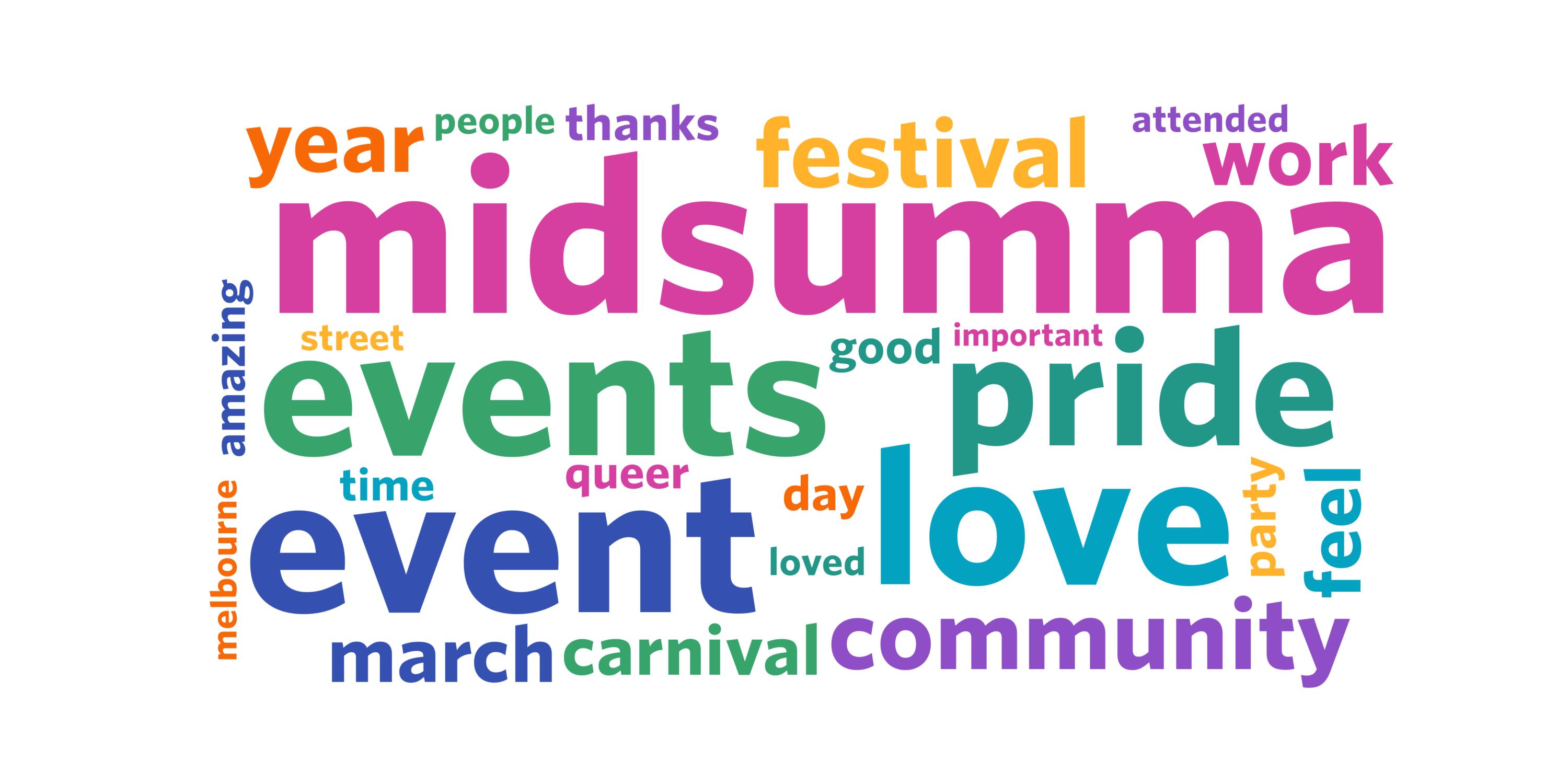
Respondents were asked to provide general feedback and comments about Midsumma Festival 2026. The word cloud below enlarges words that were repeated more frequently in the collected survey responses.
Respondents were asked to leave any additional feedback about their experience at Midsumma Festival 2026. This feedback has been classified into positive, neutral or negative categories, with the percentage of feedback sentiment types presented in the following chart. Three quarters of all responses have been classed as positive, with just 8% considered negative.
Feedback helps organisations understand where the value of visitor experiences lies and how they can be improved and strengthened in the future. A selection of comments has been highlighted below.
"Keep up the good work. This was the best program ever - high quality, diverse, exciting!"
"I really did see and feel a sense of love, celebration, unity, & comfort in all events."
"The Midsumma Pride March is the one event a year that fills me with the confidence to be exactly who I am for the whole year 🌈"
"I totally want to offer my deepest thanks to the Midsumma team: I went to the street party in Fitzroy for the first time in decades. It was totally amazing, joyful, and fun. It was so impressive to see the community together, the entertainment stages, and community tents. After 2 hours of walking about, I commented to a friend how I had felt safe the entire time of the event, and not uncomfortable at all. Well done to be able to create that level of safety. Deeply appreciated."
"This is an important festival and a highlight on the Melbourne calendar. Cheers to the Midsumma team for creating joyful spaces for people of all orientations."
"Representation matters and we love an event that works on continuously listening and improving on their experiences based on the community."
"Midsumma is one of the highlights of my year. Attending these events brings me a lot of joy and helps me learn and see things in new ways. Thanks so much to the festival committee and volunteers for all your hard work to enable this awesome festival to happen."
"The administrative and box office staff of Midsumma were friendly, efficient, helpful, kind and provided great service."
"Midsumma is amazing and should happen every year for forever. It's so beautiful seeing all shapes, sizes, colours, genders etc. On full display. Much love to the whole Midsumma team that put on this fantastic event for the community!"
Spending questions ask survey respondents about how much they spent in the local area on items like shopping, food and beverage as part of their attendance at the event. Respondents are asked a separate question about expenditure on accommodation.
Respondents are asked what they would have done otherwise if it was not for their attendance at the event. This question is used to determine 'additionality', which is the percentage of spending that could be considered to be additional, or could genuinely be attributed to the event. The proportion of expenditure that would have occurred anyway is accounted for through an additional adjustment that takes into consideration the reasons why respondents are spending money in the local area and what they would have done had they not attended the event. Melbourne respondents were asked what they would have done if they hadn’t attended the event, and respondents from elsewhere were asked if attending Midsumma Festival/Victoria's Pride was a reason for their trip.
The following charts show the visitor spending and additionality results used in the economic impact analysis.
Most respondents spent less than $400 per person at the festival and in the local area before and after the event (89%), with the largest percentage spending between $0-$100 (42%), or between $100-$200 (26%).
After removing the outliers, the average spend at Midsumma events was determined as $169 per person (slightly up from from $167 in 2025).
The majority of respondents from Melbourne would not have visited the area if not for the event taking place (71%). Almost two thirds (65%) of non-Melbourne residents reported that the Midsumma Festival was their main reason for visiting Melbourne, while 13% cited the event as a contributing factor in their decision to travel to the area and an additional 5% changed their original plans to attend.
The figures below reflect the total expenditure impact of Midsumma Festival and Victoria's Pride combined.
Survey respondents were asked to estimate how much they had spent as part of their visit, the level of influence on their decision to visit, as well as indicate what they would have done if they had not visited. Combining this data with attendance figures allows an overall impact figure to be generated.
Economic impact is determined by three main factors:
Attendance: The number of people spending money (converted to the number of nights for accommodation and longer trips).
Spend: Spending in the local economy. Includes spend as part of a visit and spend on accommodation for those staying overnight. Excludes spending on tickets or other items that would be captured through organisation expenditure (i.e. to avoid double-counting).
Additionality: The percentage of spending that would not have occurred otherwise.
To calculate the economic impact on the local area, only additional visitation is included. From those visits, only expenditure that would not have otherwise occurred is considered. In this case, the economic impact is from attendees who would have otherwise stayed at home, gone to work, or those who would have done something else outside the local area.
The tables below detail a breakdown of visitation by additionality (i.e. new visits to the area because of the event), visitor expenditure (if they came and stayed in the area because of the event and any other spending they did), and total economic output.
| ORIGIN | UNIQUE ATTENDEES | EVENT/LOCAL AREA SPEND | ADDITIONALITY | TOTAL |
|---|---|---|---|---|
| Melbourne metropolitan area | 98,247 | $155 | 71% | $10,851,925 |
| Elsewhere in Victoria | 13,797 | $210 | 85% | $2,472,433 |
| Interstate | 3,189 | $458 | 66% | $963,357 |
| Overseas | 2,886 | $152 | 26% | $115,225 |
| TOTAL | 118,119 | $169 | 72% | $14,402,939 |
| ORIGIN | NIGHTS STAYED FOR EVENT | ACCOMMODATION PER NIGHT | TRIP SPEND | ADDITIONALITY | TOTAL |
|---|---|---|---|---|---|
| Melbourne metropolitan area | 9,804 | $196 | - | 71% | $1,918,363 |
| Elsewhere in Victoria | 9,990 | $127 | $186 | 85% | $3,459,737 |
| Interstate | 10,455 | $213 | $958 | 66% | $4,238,211 |
| Overseas | 3,506 | $426 | $515 | 26% | $1,885,706 |
| OVERALL AVERAGE | 33,755 | $194 | $358 | 72% | $11,502,017 |
| Total Nights Generated (attributed to festival) | 33,755 |
| Attendee Spending | $25,904,956 |
| Event/Visit | $14,402,939 |
| Accommodation | $6,906,209 |
| Trip | $4,595,808 |
| Organiser Expenditure | $3,967,192 |
| Total Direct Impact | $29,872,148 |
| Total Multiplied Impact | $86,405,658 |
For the purpose of this analysis, output multipliers derived from ABS Output Tables 2012-13 have been applied to direct impact expenditure.
Event expenditure scaled by an output multiplier of 2.95 (representing an average of national Retail and, Food and Beverage multipliers (2.88 and 2.96 respectively).
Accommodation expenditure scaled by an output multiplier of 2.83 (the national Accommodation multiplier).
Organisation expenditure scaled by an output multiplier of 2.75 (the Australian National Heritage, Creative and Performing Arts Output Multiplier).
This report has been prepared by Culture Counts. The authors would like to thank all stakeholders and staff for their participation in this research.
Date of Approval: 13 March 2026
We respectfully acknowledge the Traditional Owners of Country throughout Australia and recognise the continuing connection to lands, waters and communities. We pay our respect to Aboriginal and Torres Strait Islander cultures, and to Elders past and present.