Use your keyboard arrow keys to navigate
20k
Total Attendance
241
Events
403
Survey Responses
7
Dimension Metrics

Contents

Sydney Jewish Food Festival — Photo: Shalom

Background

Shalom Collective

Shalom Collective aims to increase the vibrancy and engagement of the Sydney Jewish community by fostering Jewish life and learning. Through Arts & Culture, Talks, Kids & Family and Leadership & Innovation programs, Shalom engages people of all ages and backgrounds in Sydney.

Shalom Collective cultivates connection and community, providing opportunities to challenge and inspire individuals.

Attendance Statistics
Term2024 Actuals2023 Actuals2022 Actuals2021 Actuals2020 Actuals
Total number of young adult participations14,86110,8328,6716,9236,023
Total number of unique young adult participants4,6443,4913,128 (36%)3,1473,170
Total participations (excluding supported programs)26,58716,06512,5689,58510,078
Total participations (including supported programs)29,12620,04814,85611,67011,723
Total number of unique participants6,3305,1825,3055,3045,983
The average number of times a participant engaged with Shalom4.23.12.82.21.9
Number of events241239291168135

Evaluation Methodology

Shalom Collective used Culture Counts to evaluate its annual activity. An annual survey was distributed by Shalom to program attendees and participants, shared via email and social media. Two additional surveys evaluated Sydney Jewish Food Festival and Sydney Jewish Writers Festival.

In partnership with Culture Counts, these surveys were designed and developed to evaluate the strategic goals and outcomes of Shalom Collective. The surveys were updated in 2024 after a strategic review was conducted at the end of 2023.

403 responses were collected in 2024. 259 responses were collected from the annual survey, 96 from the Sydney Jewish Food Festival and 53 from the Sydney Jewish Writers Festival.

Each survey contained a range of ‘dimension’ questions, asking stakeholders about their experience of Shalom Collective activities. These dimensions have been developed and tested in collaboration with industry, practitioners and academics to measure the impact and value of arts and cultural events and activities. In 2024, a new custom metric called 'Knowledge' was added. As such, a previously used similar dimension called 'Relevance' was removed.

Appropriate dimensions were chosen based on their alignment with Shalom Collective's strategic objectives. Three additional custom dimensions were also added.

Culture Counts Dimensions
DomainDimensionDimension statement
QualityConceptIt was an interesting idea/programme
CulturalHeritageIt made me feel connected to a shared history/culture
MeaningIt moved and inspired me
InsightIt helped me gain new insight or knowledge
SocialInclusionIt made me feel welcome and included
ConnectionIt helped me to feel connected to people in the community
CommunityCommunity Pride It made me feel proud of my community
Shalom Collective Custom Dimensions
DomainDimensionDimension statement
ShalomVibrancyShalom enhances the overall vibrancy of the Sydney Jewish community
ConnectionShalom helps me feel connected to people in the Sydney Jewish community
EngagementShalom programs enhance my engagement with the Sydney Jewish community
KnowledgeShalom has improved my knowledge of Jewish rituals and ideas

Dimensions are assessed on a Likert scale, in which respondents move a slider to a point that indicates whether they agree or disagree with the dimension statement. An example of a dimension question in the Culture Counts survey tool is presented below.

likert scale example
Sydney Jewish Food Festival — Photo: Shalom

Respondent Profile

Demographics

Survey respondents were asked to provide their age, gender, and identity. This data identifies the demographic sample of people who responded to the survey and took part in the event. It enables data to be matched to the wider population and responses to be filtered to understand differences in demographics.

The following charts show the proportion of survey responses captured for each of the age, gender, and identity demographic questions.

Loading...
Loading...
Categories with fewer than 10 responses have reduced opacity to indicate that the value(s) may not be representative due to the small sample size
Loading...
Loading...
Categories with fewer than 10 responses have reduced opacity to indicate that the value(s) may not be representative due to the small sample size.
Loading...
Loading...
Categories with fewer than 10 responses have reduced opacity to indicate that the value(s) may not be representative due to the small sample size.

Insights

The highest proportion of survey respondents were aged 30-39 (28%), followed by those Over 60 (26%) and those aged 40-49 (25%). 7% of respondents were aged 20-29 and 14% were aged 50-59.

When comparing by program, ‘PJ Library’ (47%) and ‘Sydney Jewish Food Festival’ (39%) attracted the greatest proportion of those aged 30-39. 38% of respondents who attended ‘Adamama Jewish Roots Festival’ were aged 40-49. Most events attracted a smaller proportion of respondents aged 50-59, with ‘Limmud (Supported by Shalom) showing the greatest proportion (25%) of this age group.

On average, females made up the majority of survey respondents (69%). 29% identified as male and less than 2% preferred to identify in another way.

44% of the sample indicated they were born overseas, with 14% indicating they spoke a language other than English at home. Most of the programs followed the overall trend in respect to identity, though interestingly, three programs skewed towards those who were born overseas; ‘Adamama’ (71%) and ‘Adamama Jewish Roots Festival’ (75%). This suggests that these programs are particularly important for those looking to connect and meet with others and grow social connections.

‘Sydney Jewish Food Festival’ and ‘Sydney Jewish Writers Festival’ seemed to attract a more diverse audience when compared to other events, with those identifying as LGBTQIA+, as a person with disability and as someone using a language other than English at home showing notable representation in the sample.

PJ Library — Photo: Shalom

Group Composition

Respondents were asked to provide information on how many people they attended Shalom Collective events with and who they had attended with.

Loading...
Loading...
Average Group Size: 2.8
Loading...
Loading...

Insights

The average group size was determined to be 2.8 with 34% stating they attended in a group of 2. Almost half of the sample (45%) indicated they attended programs 'with friends', followed by those who attended with family (40%). 30% of the sample attended programs alone or with their partner (26%).

Naturally, 'PJ Library' was a program that was most likely to engage groups with children under 18 (70%). Attendees to the ‘Sydney Jewish Food Festival’ (53%) and ‘Sydney Jewish Writers Festival’ (47%) were most likely to attend alone, though notable proportions of respondents also stated they attended in groups of two (35% and 53% respectively). This suggests a diverse engagement profile for these events.

Adamama Jewish Roots Festival — Photo: Shalom

Denomination & Identity

Respondents were asked about their sense of Jewish identity and their denomination. Results have been split by program for comparative purposes. These comparisons allow Shalom to understand how these factors may influence engagement.

Results from the identity question have been compared to those received in Shalom Collective's Gen17 research to demonstrate how its audience profile may have changed over time.

Jewish identity was asked across a 5-point scale. The scale sought to measure three components of Jewish identity:

  • How strongly the individual personally identified as Jewish

  • The social network a respondent had, and whether this network was significantly Jewish

  • The level of engagement a respondent had within the broader Jewish community

The results for both questions are shown below.

Loading...
Loading...
Note: Categories with fewer than 10 responses have reduced opacity to indicate that the value(s) may not be representative due to the small sample size. Options have been shortened for illustrative purposes. See footnote for full response options.
Loading...
Loading...
Categories with fewer than 10 responses have reduced opacity to indicate that the value(s) may not be representative due to the small sample size.
Loading...

Insights

Just over half the sample (52%) of respondents identified with having a strong Jewish identity, network and engagement. This response option was the most-commonly cited option across all programs, particularly ‘Limmud (Supported by Shalom)’ (71%).

Overall, 26% of respondents identified as having a strong Jewish identity and network, but weak engagement with the Jewish community. 2% identified as having a weak identity, network and no engagement. Those who attended ‘PJ Library’ were most likely to identify as having a strong identity but weak network and engagement (22%).

When asked if they identified with a particular denomination, 27% identified as Traditional. 18% of respondents identified as 'Just Jewish', up from 11% the previous year.


Note: Respondents to the question 'Do you identify as any of the following?' were presented with five different options.

  1. I have a strong Jewish identity, the majority of my social network is Jewish, and I am actively involved in helping create a strong and vibrant Jewish community.

  2. I have a strong Jewish identity, the majority of my social network is Jewish, but I am not actively involved in helping to create a strong and vibrant Jewish community.

  3. I have a Jewish identity, the majority of my social network is not Jewish, and I am not involved in actively creating a strong and vibrant Jewish community.

  4. My Jewish identity is not a major factor to my life, the majority of my social network is not Jewish, and I only get involved in Jewish activities if they align with my interests or passions.

  5. My Jewish identity is not a major factor to my life, the majority of my social network is not Jewish, and I am not involved in Jewish activities.

Adamama — Photo: Shalom

Location & Postcode

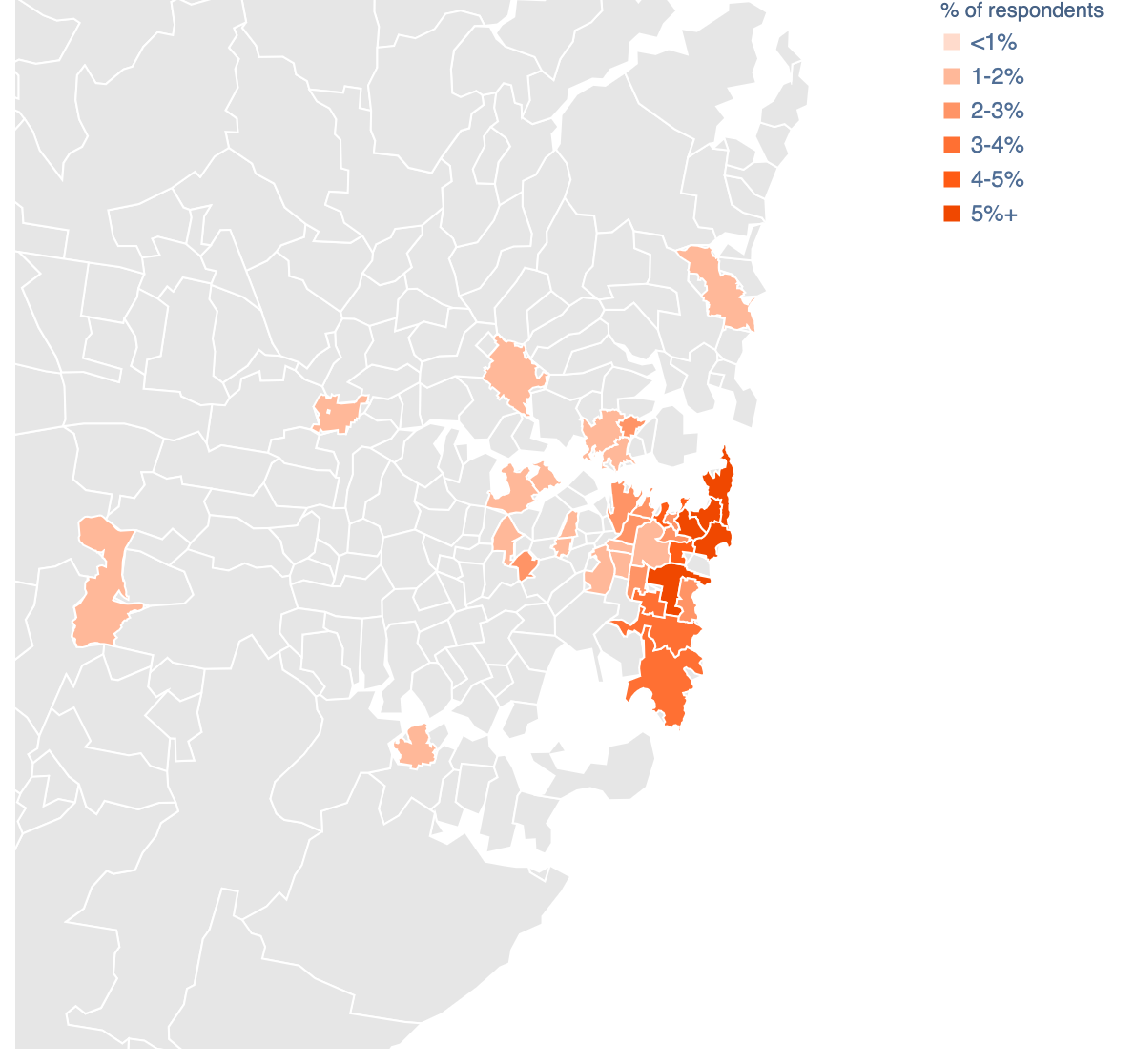
Respondents were asked to provide their postcode, This data identifies the demographic sample of people who responded to the survey and took part in the survey and their living locations.

Loading...
Respondent Residence by Postcode - Sydney
What is your postcode?
Postcode heatmap visualising proportions of respondents.

Insights

The most commonly cited postcode was Bondi (13.6%), followed by Rose Bay (8.5%). Clovelly and Bellevue Hill each accounted for 7.4% of the sample.

The Sydney heatmap provides a visual representation of respondent living locations.

Yentyl, Malthouse Theatre — Photo: Jeff Busby

Engagement

Program Engagement

Survey respondents were also asked to indicate which Shalom Collective programs they attended. The following charts show which programs respondents engaged in 2024, how many communal events they attended.

Loading...
Loading...

Insights

When asked which programs they engaged in 2024, respondents were able to select more than one option. Over one third of all respondents (40%) had engaged with 'Theatre: Yentl at the Sydney Opera House'. This was followed by ‘Sydney Jewish Food Festival’ (37%), ‘Sydney Jewish Writers Festival’ (31%) and ‘PJ Library’ (30%).

8% did not engage with any programs in 2024, a much lower result than 2023 (18%) and 2022 (16%). 80% of respondents were aware that Shalom Collective delivered the programs listed, a result that suggests increased success regarding brand awareness and engagement in 2024. 39% of respondents were not aware that Shalom Collective delivered programs in 2023, compared to 15% in 2024.

Sydney Jewish Food Festival — Photo: Shalom

First Time

Respondents to the 2024 surveys were asked if this was the first year they were engaging with Shalom. This was a new metric added to the 2024 surveys.

Loading...

Insights

Over three quarters ofthe sample (77%) indicated that they had engaged with Shalom Collective previously. The remaining 23% stated this was their first time. These results suggest a strong ability to attract and retain a loyal patron-base, whilst still encouraging first-time engagement from the Jewish community.

Sydney Jewish Writers Festival — Photo: Shalom

Wider Engagement

Respondents were asked about other Jewish organisations and communities they engage with. This question helps Shalom understand how its programs contribute to the wider Jewish ecosystem.

A new question was added in the 2024 survey to asked about frequency of engagement with arts and cultural activity, as well as Jewish communal activities. This helps inform the frequency of engagement that Shalom Collective audiences undertake for other related activities.

Loading...
Loading...

Insights

The majority of respondents said they had engaged with Synagogues in the past 12 months (77%). Interestingly, 47% of respondents said they engaged with Sydney Jewish Museum, making it the most popular cultural institution visited by Shalom Collective attendees in both 2023 (51%) and 2024.

A large proportion of Shalom Collective's audience engage with arts and cultural events at least once a month (31%), with a further 36% engaging with these events every couple of months. Respondents were more likely to engage with Jewish communal events once a week (17%) compared to arts and cultural events (11%), suggesting the organisation plays an integral role in respondents' engagement with their local community.

Adamama — Photo: Shalom

Motivations

In the 2023 survey, a new question was added to ask respondents about their motivations for engaging with Shalom Collective programs. The list of options was created by Culture Counts in partnership with Shalom Collective. These options were updated in the 2024 survey, after a strategic review.

Loading...
Loading...
Loading...

Insights

When considering motivation for engagement, to 'connect to the Jewish community' was the most popular response (81%) followed by ‘to feel a sense of belonging’ (71%). Other motivations relating to Jewish identity, such as ‘to explore my Jewish identity’ (63%) and ‘a new way to connect to my Jewish identity’ (47%) were also chosen by a significant proportion of the sample.

When considering specific programs, 91% of ‘Sydney Jewish Food Festival’ attendees stated their motivation as ‘to connect to my Jewish community’. This cohort was less likely to state ‘to meet new people’ (36%) as a motivating factor. A significant proportion (81%) of ‘Limmud (Supported by Shalom)’ attendees stated their motivation for attending was ‘to explore my Jewish identity’ – a result considerably higher to other programs. ‘To meet new people’ was also generally selected less often across each program.

Shir Songs of Hope at Sydney Town Hall — Photo: Shalom

Outcomes

Survey respondents moved a slider to indicate whether they agreed or disagreed with the included dimension statements in relation to the event. The first tab chart contains the response data for 'public' responses, showing the average result for each dimension.

The second tab shows the interquartile range of responses for each dimension. These ranges represent the middle 50% of responses, which are areas on the slider where most responses typically fell. Accompanying this range is the median result for each dimension (i.e. the most common response). Smaller ranges indicate similarity in agreement between respondents, whereas larger ranges indicate a wider spread of responses.

The Culture Counts platform provides various methods to capture survey responses at a minimal marginal cost. Achieving larger samples enables organisations to be more confident about the average results and that the opinions of the survey respondents are representative of all attendees. The accompanying margin of error chart shows the expected differences for the associated dimension results calculated at a 95% confidence level.

Outcome Averages

Loading...
Loading...
Loading...
Categories with fewer than 10 responses are shown as white dots to indicate that the value may not be representative due to the small sample size.
Loading...

Insights

Of all dimensions measured, 'Community Pride' and 'Concept' (85/100) received the highest average scores. This was followed by 'Inclusion’ (82/100), and 'Connection' and 'Heritage'which both scored (81/100). This suggests that respondents were most likely to agree that the programs made them feel proud of their community, that it was an interesting idea/programme and that it connected them to people in their community.

Although still receiving positive results, the lower scoring dimensions were 'Insight’ (67/100) and ‘Meaning’ (73/100). This suggests that respondents were less likely to agree that it helped them to gain new insight or knowledge and that it moved and inspired them. Results were most consistent across programs for ‘Concept’ (86-91/100). Notably, the highest average was recorded for ‘Inclusion’ (97/100) by ‘Adamama Jewish Roots Festival’ attendees, suggesting this cohort was highly likely to agree that the event made them feel welcome and included.

'Meaning' had the largest interquartile range meaning respondents produced the most varied results for this dimension.

At a 95% confidence level, the margin of error for dimensions ranged from 2.3% to 3.6%. This means that we can be 95% confident that if we surveyed the entire audience, the average outcome for 'Inclusion' would fall within 3.0% of the average results generated by the sample.

Adamama Jewish Roots Festival — Photo: Shalom

Shalom Collective Metrics

Four custom metrics were added to the Shalom Collective evaluation. These metrics were:

  • Vibrancy: Shalom enhances the overall vibrancy of the Sydney Jewish community

  • Connection: Shalom helps me feel connected to people in the Sydney Jewish community

  • Engagement: Shalom programs enhance my engagement with the Sydney Jewish community

  • Knowledge: Shalom has improved my knowledge of Jewish rituals and ideas

Survey respondents moved a slider to indicate whether they agreed or disagreed with the included dimension statements in relation to the event. The first chart shows the average result for each dimension.

The second chart shows the interquartile range of responses for each dimension. These ranges represent the middle 50% of responses, which are areas on the slider where most responses typically fell. Accompanying this range is the median result for each dimension (i.e. the most common response). Smaller ranges indicate similarity in agreement between respondents, whereas larger ranges indicate a wider spread of responses.

Loading...
Loading...
Loading...
Categories with fewer than 10 responses are shown as white dots to indicate that the value may not be representative due to the small sample size.

Insights

'Vibrancy' was the highest scoring custom dimension (84/100), this was followed by 'Connection' (83/100) and 'Engagement' (82/100). Notably, ‘Knowledge’ (68/100) demonstrated a considerably lower average suggesting respondents were less likely to agree that Shalom has improved their knowledge of Jewish rituals and ideas. ‘Knowledge’ also had the largest interquartile range, indicating respondents were less likely to consistently agree with this statement.

Shir Songs of Hope at Sydney Town Hall — Photo: Shalom

Event Experience

A new question was added to surveys in 2024 that asked respondents to identify common experiences, based on a short list provided within the survey. This prompted list provided respondents an opportunity to report which event experiences most likely matched their own experience at Shalom events.

Loading...
Loading...

Insights

When asked which statements apply to their experience of Shalom events, just over half (51%) stated that 'the event felt inclusive'. This was followed by 'the event offered a variety of experiences' (36%) and 'I tried or learned about new products/services' (32%). Similar proportions of respondents (28% and 27% respectively) selected 'I shared my experience with others' and 'the event seemed to offer something for everyone' from the list of statements. 'I can apply what I learned/experienced' was chosen the least (14%).

Adamama Jewish Roots Festival — Photo: Shalom

Overall Experience

Respondents were asked about their overall experience of attending Shalom Collective events, with a choice of five options - Excellent, Good, Neutral, Poor, and Terrible.

This chart shows the percentage of respondents that rated the events overall across these five options and the results per event.

Loading...
Loading...
Loading...

Insights

The majority of aggregate respondents (85%) reported a positive overall experience. Of this, 43% reported an 'excellent' experience and 42% reported their experience as 'good'. Both 'neutral' and 'poor' experiences comprised 8% of the sample and only 1% reported a 'terrible' experience.

When looking at the program breakdown, 'Shir Songs of Hope at Sydney Town Hall' had the highest proportion of 'excellent' responses (77%). 'Adamama Jewish Roots Festival' (67%), 'Limmud (Supported by Shalom)'' (65%) and 'Theatre: Yentl at Sydney Opera House' (66%) all had similar levels of 'excellent' experiences. Notably, 'PJ Library' was the only program that had reports of 'poor' experiences, though this cohort only comprises 3% of the sample.

Those aged 30-39 were most likely to report an 'excellent' experience (57%), whilst all other age groups had similar proportions of results. Half of the over 60 sample (50%) reported their experience as 'good'. All age groups had some level of 'poor' experiences, though the 50-59 had the highest proportion (13%).

Sydney Jewish Writers Festival — Photo: Shalom

Net Promoter Score

Respondents were asked whether they would recommend Shalom Collective events to a friend or colleague. Respondents could choose a number from 0 to 10 from a menu, with 0 meaning 'not likely at all' and 10 meaning 'extremely likely'.

These results can be used to calculate a Net Promoter Score (NPS). NPS is a standardised metric that seeks to measure loyalty between an organisation and its audience. Respondents with a score of 9 or 10 are considered 'Promoters'. 'Detractors' are those who respond with a score of 0 to 6. Scores of 7 and 8 are considered 'Passives'.

NPS is calculated by subtracting the percentage of respondents who are Detractors from the percentage of customers who are Promoters. This means that an overall Net Promoter Score can range between -100 to +100.

This chart shows the proportion of respondents that would or would not recommend Shalom Collective events, followed by the calculated NPS below.

Loading...
Net Promoter Score: 42

Insights

54% of respondents rated Shalom events either 9 or 10, indicating they would be classified as Promoters. 34% of respondents had passive results (7 or 8) and 12% would be considered detractors (scoring between 0-6).

An NPS that is positive (i.e. higher than zero) is felt to be good, and an NPS of 50+ is excellent. Shalom's NPS of 42 (up from 30 in 2023) indicates that audiences have a strong level of loyalty towards Shalom events and are likely to promote them when speaking with others.

Sydney Jewish Writers Festival — Photo: Shalom

Importance

In 2024, respondents were asked about how the importance of being Jewish had changed. They were also asked specifically about whether they felt Shalom Collective events would have an impact on them in the future. This prompted question help qualify the strategic objective and delivery of events for attendees and participants.

Loading...
More Important: 73%
Loading...
Loading...
Loading...
Loading...
Loading...

Insights

73% of the sample indicated that being Jewish has become 'more important' to them over the last 12 months. 21% stated that there has been 'no difference'.

When considering results by program, similar proportions of respondents indicated that it has become 'more important'. 'Shir Songs of Hope at Sydney Town Hall' were slightly more likely to agree (79%).

Respondents aged 30-39 (84%) and over 60 (77%) were more inclined to state that being Jewish has become 'more important' over the last 12 months. 20-29 year olds were the only group to indicate that it has become less important, with 9% responding this way.

Shir Songs of Hope at Sydney Town Hall — Photo: Shalom

Year-on-Year Comparison

The responses from those who indicated that they had engaged with any of the 2024 programs have been compared to data collected in 2023, 2022, 2021, 2020. Note that some metrics were not asked every year, as the survey was refined. This comparison shows data asked in the 2024 surveys, accordingly.

Loading...
Loading...
Loading...
Loading...
Note: The 'Knowledge' question format was changed in the 2023 survey to align with the other custom metrics. 2020 to 2022 comparisons using the previous format are available here.

Insights

74% of respondents felt that being Jewish had become more important in 2024, an increase of 8% in 2023. Comparing this to the results of the 2022 (42%) and 2020 (30%) surveys, it is clear there has been consistent growth here, with the 2024 result most likely related to the current political climate.

Awareness of Shalom's involvement in delivering programs showed a marked increase in 2024, growing from 52% of respondents being aware to 85%. 2023 respondents were more likely to be aware that Shalom delivered 'some, but not all' programs they engaged with (39%).

Two of the five comparable dimensions showed an increase in averages from 2023 results - 'Concept' (+2/100) and 'Inclusion' (+4/100). This suggests that 2024 respondents are more likely to agree that it was an interesting idea/programme and that it made them feel welcome and included. Conversely, 'Insight' saw the greatest drop in average (-6/100), suggesting 2024 respondents were less likely to agree that it helped them gain new insight or knowledge.

Custom Shalom metrics all trended upwards in 2024, with each average reaching its highest recorded level. Of the metrics that have been consistently measured since 2020, 'Connection' (81/100, up 7/100 from 2023) saw the greatest increase, followed by 'Engagement' (81/100, up 6/100 from 2023). This suggests that respondents have stronger levels of agreement regarding Shalom helping them feel connected to people and enhancing engagement with the Sydney Jewish Community.

Adamama Jewish Roots Festival — Photo: Shalom

Comments and Feedback

Sentiment Analysis

Respondents were asked to leave any additional feedback about their experience at Shalom Collective. This feedback has been classified into positive, neutral, or negative categories, with the percentage of feedback sentiment types presented in the following chart.

Loading...

General Feedback

Feedback helps organisations understand where the value of visitor experiences lies and how they can be improved and strengthened in the future. A selection of comments have been highlighted here.

Thank you for providing these absolutely wonderful events - what I love is that you cater for the young ones to connect to their Judaism and reminds us how proud it is to be Jewish - it also brings family and old friends together

I really admire the work you do and would love to more involved in the future

All the events I attended this year have been so passionate and filled with so much love. This is so much of what I and many of us needed this year.

The events represented my connection with Judaism more than any synagogue

PJ Library/Adamama Jnr could be more inclusive of Mizrahi/Sephardi stories and a little more queer.

More young adult events! Please bring back Shabbat Dinners etc. Not sure why support is being diverted to Moishe House - that seems to benefit only a few people.

You need to make more young people aware of your programmes. You are speaking to the same people everytime rather than extending your reach.

We went to the PJ library end of year Chanukah event, had great expectations and it sounded lovely, the event itself was really disappointing Ang underwhelming with really not much to do. My son and I walked around to each table, I asked him if he wanted to do anything and there was just not much that was really captivating (if you don’t like doing crafts, there was nothing else) so we left after being there for a whole 5 minutes. Even though the tickets weren’t expensive it wasn’t worth paying what was offered. Disappointing as I’ve been to other PJ library events before and they’ve been better.

The food at Limmud is terrible (and overpriced). No other way to describe it.

If you provided some interesting guest speakers for 60 plus age group

Sydney Jewish Writers Festival — Photo: Shalom

Topic Analysis - General Feedback

Thematic analysis was performed on freetext question responses to find common themes (or 'topics') discussed by respondents. Respondents were asked if they had any general feedback or comments about Shalom Collective events they would like to share, as part of the annual survey.

The themes found in the responses to freetext questions in the annual survey are broken down in detail below.

Please add any other comments or feedback about our events here.

Loading...

1. PJ Library Feedback (37%)

Responses highlight the excitement and appreciation for the books provided by PJ Library, noting their role in teaching Jewish values, celebrating festivals, and reinforcing cultural identity. The mention of 'Shalom' and other programs illustrates a community's gratitude and engagement with cultural resources.

"We enjoy and appreciate the PJ library books very much. My kids feel so excited when the delivery arrives and the stories help us to connect and reinforce ideas around chaggim and Jewish values. I have also enjoyed learning about other Shalom programs this year (e.g. Adamama, Shir). Even where I have not been able to personally attend, it has been important and valuable to know that these programs exist and are available to strengthen connections and identity in our community. Thanks for your work, Shalom." - Age 38

"I haven’t been to Shalom events but receive PJ library books which we are grateful for, thank you. I find them meaningful, beautifully illustrated and love sharing them with our children." Age not provided

"My daughter loves recieving her PJ library books. They form a big part of how we celebrate the Jewish festivals and how we talk about our Jewish identity so thank you!" - Age 40

"The PJ Library is an invaluable program for my kids and family, especially because we live in a regional area. Deeply appreciated indeed." - Age 50

2. Event Appreciation (24%)

Respondents showed an appreciation for the events run by Shalom, and many expressed praise for well-organised events and enjoyable experiences. Respondents also showed enthusiasm for future participation.

"Absolutely loved the songs of hope event. Was strong and entertaining, motivating and inspiring. Ben Adler was exceptional. Thank you shalom for supporting such organisations. The food festival was so well organised and enjoyable. The writers festival was interesting and thought provoking." - Age not provided

"I loved attending the Adammama shabbaton- i attended without knowing much about it and had a great time. It introduced me to the Adammama community and events that Ellik and his team offer. It is a fun and inclusive environment- especially it makes gardening accessible for those with accessibility needs. Please keep it going." - Age 26

"Looking forward to experiencing the writer's event and Limmud this year" - Age 37

"Shir was a remarkable professional musical event, in an iconic jewish venue, show casing top jewish musical talent everything down to the program was perfect. absolutely delightful and perfect for what the community needs" - Age 52

3. Community Connection (43%)

This topic reflects feedback that emphasises the acknowledgement of community connection and inclusivity at events, as well as some pushback on perceived biases or assumptions made by the organisers.

"I would love there to be more focus on forging new community connections at these events" - Age 30

"This event made me opened and connected to people I didn’t even know in the community before" - Age 25

"I am very grateful to be able to attend events like these and feel a sense of connectedness, community and safety, especially since October 7th. Thank you for all your hard work" - Age 25

4. Praise for Jewish Events (27%)

This topic focuses on appreciation for the organisation and execution of Jewish literary events and awards, as expressed in responses. Feedback highlights gratitude towards these initiatives, which are aimed at supporting Jewish writers and fostering community.

"Thank you for helping to support and create these opportunities for Jewish writers, particularly the Australian Jewish book awards. I know it will be such an important award for future Jewish writers of Australia to come, not only in giving purpose to generate new work, but most importantly, a category in the Wingate for new work with Jewish subjects, which is so vital in these times. Along with nonfiction awards and young writers awards. Having representation in literature is so important. I have been so impressed with Shalom’s initiatives this year. Makes me want to move to Sydney!! Wish some of these events had the option to live stream for those interstate. Thank you again for your incredible running of the Jewish book awards at SJWF" - Age 37

"Really enjoyed seeing and sharing Jewish art" - Age 26

"So excited to see more of what shalom has in store. Sydney's jewish artists are slowly starting to see that we do have spaces for us to be openly jewish, and i dont think this could have happened without shalom's cool new programs and events! i don't know what's changed at shalom over the past year, but whatever it is please keep doing it!" - Age not provided

"Thank you for providing these absolutely wonderful events - what I love is that you cater for the young ones to connect to their Judaism and reminds us how proud it is to be Jewish - it also brings family and old friends together" - Age 65

Sydney Jewish Food Festival — Photo: Shalom

Topic Analysis - Sydney Jewish Food Festival Feedback

Thematic analysis was performed on freetext question responses to find common themes (or 'topics') discussed by respondents. A specific event survey was distributed for the Sydney Jewish Food Festival, meaning that analysis could be done on just this event.

The themes found in the responses to freetext questions in the Sydney Jewish Food Festival survey are broken down in detail below.

Please add any other comments or feedback about the Jewish Food Festival below.

Loading...

1. Crowd Size (59%)

Respondents commented on how busy the event way, with feedback related to queue times, overcrowding, and vendors who had run out of fod. This suggests respondents felt there was opportunity to improve how the event could cater for more people in the future.

"Too crowded. Too many prams. Not enough food. Long queues." - Age 47

"Needed two have double stands for food vendors as queues were very long" - Age 49

"It was a great idea and lovely to see so many products on show, however it was so overcrowded and unpleasant that one could not move. I suggest the stalls be more spread out. The queues were so long and it was not easy walking around to see what was available. There needed to be better crowd control. Some stall holders could not cope with the crowd and perhaps should have had more volunteers to help. Popular stalls ran out of food. I would suggest maybe looking at a staggered entrance then you have more idea of how many people are going to come at a certain time and would also help stall holders with an idea of how much stock is needed. Personally I couldn't wait to leave" - Age 64

"There was neither enough space nor enough food for so many people. We arrived at lunchtime, saw that it was uncomfortably crowded, that we would not be able to get food promptly and that our choices were limited, and so left to go to Grandma Moses for a sandwich. After that, we came back and enjoyed the stalls. More variety of foods would have been good. More foods or ingredients that could be bought to take home would also have been very welcome. Nonetheless, overall, I enjoyed myself." - Age 50

2. Venue Size and Logistics (53%)

Respondents reflected on the venue size and its ability to handle the amount of people at the event. They highlighted issues they experienced like congestion and suggested improvements to manage attendee flow more effectively in the future.

"The event might have been better if it could be held in a little bit bigger space. people tend to stand right next to stalls eating and talking to friends." - Age 72

"It was wonderful to see so many people relaxed and enjoying the experience. I think you and your team did an amazing job It was too small an area for the he volume of people. The stalls were to close together and hard to access With the amount of people it would have made it easier if we circulated in the same direction instead of the crush that was being experienced. Certain stalls had excessive price which was a bit off putting. All up I believe a fantastic job was achieved" - Age 74

"There were too many people in a small space so it felt very crowded. At least 3 people mentioned to me that it was great for a bit but then became unbearable with the crowd. Either: 1. Book a bigger venue 2. Stagger the people and offer tickets for specific times of the day. This way you can also ensure food doesn't run out at a specific time. I would advise that when you notify people for next year you note that you have improved in this area and it wont happen again so you still get the same turn out and make sure people are not deterred from coming due to it being overcrowded. Keep up the amazing work, it's so great to have this in our community." - Age 41

"It was wayyyyy too crowded. It could have been much more spread out so we were not all on top of each other like cramped cattle. There could have been designated barriers to show which queue lines were which and avoid the tumult and confusion and chaos. There must be a bigger venue?" - Age 50

3. Festival highlights (34%)

Many respondents had positive remarks about the festival's atmosphere and concept. The frequent use of words such as 'great', 'food', and 'crowds' indicate a well-received event.

"Great job! Lots of fun, great vibe" - Age 42

"Really well done experience" - Age 34

"The festival was great however the queues to purchase food was too long. I don’t know what the solution is but having to wait for 45mins just to order is far too long" - Age 72

4. Kosher Delight (34%)

There was an emphasis on the food and kosher options, with responses recording an appreciation for the kosher offerings available. It highlights a blend of positive feedback and suggestions for future food offerings.

"This was an excellent event and for kosher consumers it was such a treat to be able to experience foods that ordinarily wouldn't be kosher. A big shout out to TA TA TA pizza which was delicious!" - Age 36

"I was keen to try kosher food provided by places that are not normally kosher. Unfortunately the pizza ran out (after we had been waiting in a queue for more than thirty minutes.) Overall, I was impressed by how many stalls there were that were kosher. Looking forward to next year." - Age 40

"It was a great event. However I felt that it was more of a kosher food festival rather than a Jewish food festival. As amazing as it is to have so many kosher options available to us, omg donuts and Mendy’s pizza (I love them both, just using them as an example) don’t really showcase Jewish food. There is nothing Jewish about pizza and gluten free donuts. I think it would be exciting to have a stall from different countries, each offering a Jewish food from their culture. I realize this may be slightly trickier to coordinate but it would be fabulous 🤩" - Age 40

"Its great that all the food was Kosher, it was a very good incitive and should happen again" - Age 68

Yentyl, Malthouse Theatre — Photo: Shalom
Data and Insights by
Report prepared for

This report has been prepared by Culture Counts. The authors would like to thank all stakeholders and staff for their participation in this research.

Approved by: Jordan Gibbs
Date of Approval: 7 February 2025

We respectfully acknowledge the Traditional Owners of Country throughout Australia and recognise the continuing connection to lands, waters and communities. We pay our respect to Aboriginal and Torres Strait Islander cultures, and to Elders past and present.