Shalom Collective aims to increase the vibrancy and engagement of the Sydney Jewish community by fostering Jewish life and learning. Through Arts & Culture, Talks, Kids & Family and Leadership & Innovation programs, Shalom engages people of all ages and backgrounds in Sydney.
Shalom Collective cultivates connection and community, providing opportunities to challenge and inspire individuals.
| Term | 2025 Actuals | 2024 Actuals | 2023 Actuals | 2022 Actuals | 2021 Actuals | 2020 Actuals |
|---|---|---|---|---|---|---|
| Total number of young adult participations | 19,864 | 14,861 | 10,832 | 8,671 | 6,923 | 6,023 |
| Total number of unique young adult participants | 4,729 | 4,644 | 3,491 | 3,128 | 3,147 | 3,170 |
| Total participations (excluding supported programs) | 30,814 | 26,587 | 16,065 | 12,568 | 9,585 | 10,078 |
| Total participations (including supported programs) | 34,661 | 29,126 | 20,048 | 14,856 | 11,670 | 11,723 |
| Total number of unique participants | 7,336 | 6,330 | 5,182 | 5,305 | 5,304 | 5,983 |
| The average number of times a participant engaged with Shalom | 4.2 | 4.2 | 3.1 | 2.8 | 2.2 | 1.9 |
| Number of events | 153 | 241 | 239 | 291 | 168 | 135 |
Shalom Collective used Culture Counts to evaluate its annual activity in 2025. An annual survey was distributed by Shalom to program attendees and participants, shared via email and social media. Three additional surveys evaluated Sydney Jewish Food Festival, Jewish Poetry Project, and the Recollections Exhibit.
Developed in partnership with Culture Counts, the surveys were designed to evaluate the strategic goals and outcomes of Shalom Collective. The surveys were updated in 2024 after a strategic review was conducted at the end of 2023.
345 responses were collected in 2025. 66 responses were collected from the annual survey, 171 from the Sydney Jewish Food Festival, 56 from the Jewish Poetry Project, and 47 from the Recollections Exhibit.
This report provides results for all survey responses in aggregate, as well as breaking down responses by event. The charts show results for the three individually-surveyed programs (Sydney Jewish Food Festival, Jewish Poetry Project, and the Recollections Exhibit), and for additional events that were included in the annual survey ('Other Programs' charts).
Each survey contained a range of ‘dimension’ questions, asking stakeholders about their experience of Shalom Collective activities. These dimensions have been developed and tested in collaboration with industry, practitioners and academics to measure the impact and value of arts and cultural events and activities.
Appropriate dimensions were chosen based on their alignment with Shalom Collective's strategic objectives. Four custom dimensions were also used.
| Domain | Dimension | Dimension statement |
|---|---|---|
| Qualities | Concept | It was an interesting idea/programme |
| Cultural | Heritage | It made me feel connected to a shared history/culture |
| Meaning | It moved and inspired me | |
| Insight | It helped me gain new insight or knowledge | |
| Social | Inclusion | It made me feel welcome and included |
| Connection | It helped me to feel connected to people in the community | |
| Community | Community Pride | It made me feel proud of my community |
| Domain | Dimension | Dimension statement |
|---|---|---|
| Shalom | Vibrancy | Shalom Collective enhances the overall vibrancy of the Sydney Jewish community |
| Connection | Shalom Collective helps me feel connected to people in the Sydney Jewish community | |
| Engagement | Shalom Collective programs enhance my engagement with the Sydney Jewish community | |
| Knowledge | Shalom Collective has improved my knowledge of Jewish rituals and ideas |
Dimensions are assessed on a Likert scale, in which respondents move a slider to a point that indicates whether they agree or disagree with the dimension statement. An example of a dimension question in the Culture Counts survey tool is presented below.

Survey respondents were asked to provide their age, gender, and identity. This data identifies the demographic sample of people who responded to the survey and took part in the various events. It enables data to be matched to the wider population and responses to be filtered to understand differences in demographics.
The following charts show the proportion of survey responses captured for each of the age, gender, and identity demographic questions. The results are shown for all surveys in aggregate, for the three individually-surveyed events, and for other programs captured via the annual survey.
The highest proportion of survey respondents were aged over 60 (36%). 29% of respondents were under 40 years of age.
When comparing by surveyed program, the Jewish Food Festival captured the largest percentage of respondents under 40 (36%), while the Recollections Exhibition captured the least (7%). For other programs captured via the annual survey, PJ Library had the largest percentage of under 40 year old respondents (43%).
Females made up the majority of survey respondents, with 69% across all surveys. 28% identified as male and 2% preferred not to provide a gender. Proportions were similar for the surveyed programs, while Shir Songs of Hope recorded a higher percentage of male responses (44%). Note that the samples for 'Other Programs' are small.
43% of the aggregate sample indicated they were born overseas, with 13% speaking a language other than English at home. Identity percentages were similar across the surveyed and other programs, with more than 40% of respondents for all programs being born overseas.
Respondents were asked to provide information on how many people they attended Shalom Collective events with and who they attended with.
The average group size was determined to be 3.1 with 52% stating they attended in a group of 2.
Roughly equal numbers of respondents indicated they attended programs with friends (35%), with family (37%), or with a partner (35%). 23% of the sample attended programs alone, while 16% attended with children under 18 years.
People were most likely to attend Jewish Poetry Project alone (42%), while Jewish Food Festival was most commonly attended with family (40%), and Recollections was most commonly attended with friends (43%).
Large percentages attended PJ Library and Jewish Food Festival with children under 18 years (60% each).
Respondents were asked about their sense of Jewish identity and their denomination. Results are provided in aggregate and split by program for comparative purposes. These comparisons allow Shalom to understand how these factors may influence engagement.
Jewish identity was asked across a 5-point scale. The scale sought to measure three components of Jewish identity:
How strongly the individual personally identified as Jewish
The social network a respondent had, and whether this network was significantly Jewish
The level of engagement a respondent had within the broader Jewish community
The results for both questions are shown below.
Just over half the sample (51%) identified with having a strong Jewish identity, network and engagement. This response was the most-commonly cited option across all programs, particularly Anne Being Frank (72%).
Overall, 24% of respondents identified as having a strong Jewish identity and network, but weak engagement with the Jewish community. 4% identified as having a weak identity, network and no engagement. Those who attended PJ Library were most likely to identify as having a strong identity but weak network and engagement (43%).
When asked if they identified with a particular denomination, 23% identified as Traditional and 18% as Modern Orthodox. 15% of respondents identified as 'Just Jewish', down slightly from 18% the previous year.
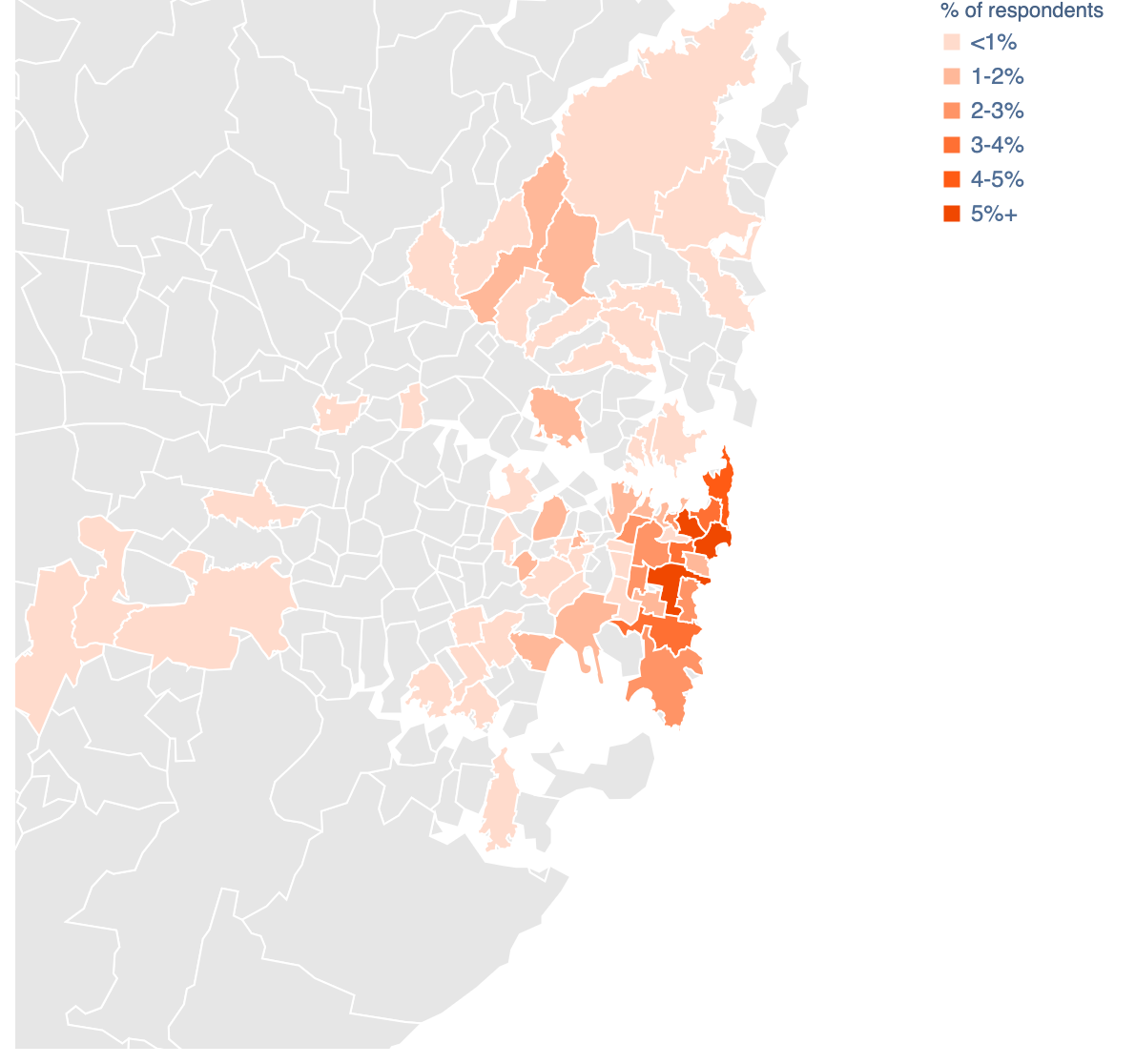
Respondents were asked to provide their postcode, with data identifying the geographic spread of attendees across metropolitan Sydney and NSW.
The most commonly cited postcode was Bondi (14.4%), followed by Clovelly (7.4%) and Bellevue Hill (6.7%). Other inner urban and eastern suburbs of Sydney were also frequently cited.
The Sydney heatmap provides a visual representation of respondent living locations.
Annual survey respondents were asked to indicate the Shalom Collective programs that they attended in 2025. The following charts show the frequency of selected programs and awareness of Shalom Collective as the delivery partner.
Respondents were able to select multiple options from the event list. Over a third of respondents (41%) engaged with the Jewish Food Festival (41%), Shir Songs of Hope (34%), and Anne Being Frank (34%).
16% did not engage with any of the listed programs in 2025, on par with 2023 (18%) and 2022 (16%), but up from 8% in 2024. 89% of respondents were aware that Shalom Collective delivered the programs listed (up from 80% in 2024), a result that suggests increased success regarding brand awareness and engagement. Just 9% of respondents were not aware that Shalom Collective delivered these programs in 2025, compared to 15% in 2024.
Respondents to the 2025 surveys were asked if this was the first year they were engaging with a Shalom Collective program.
Over three quarters of the sample (79%) indicated that they had engaged with Shalom Collective previously. The remaining 21% stated that this was their first time, up from 23% of first time attendees in 2024. The results suggest a strong ability to attract and retain a loyal patron-base, whilst still encouraging first-time engagement from the Jewish community.
Respondents were asked about other Jewish organisations and communities they engage with. This question helps Shalom understand how its programs contribute to the wider Jewish ecosystem.
A question was added in the 2024 survey to ask about frequency of engagement with arts and cultural activity, as well as Jewish communal activities. This helps inform on related activities undertaken by Shalom audiences.
The majority of respondents said they had engaged with Synagogues in the past 12 months (65%). Interestingly, 44% of respondents said they engaged with Sydney Jewish Museum, making it the most popular cultural institution visited by Shalom Collective attendees in 2023 (51%) and 2024 (47%).
A large proportion of Shalom Collective's audience engage with arts and cultural events at least once a month (36%), with a further 18% engaging with these events every couple of months. Respondents were more likely to engage with Jewish communal events once a week (18%) compared to arts and cultural events (10%), suggesting the organisation plays an integral role in respondents' engagement with their local community.
Respondents were asked about their motivations for engaging with Shalom Collective programs. Results are displayed in aggregate, and for Jewish Food Festival and Recollections Exhibition individually. The sample for other programs is not large enough to draw relevant insights. Results are also pivoted by age.
'To connect to my Jewish community' was the most popular response across all surveys (60%) followed by ‘to feel a sense of belonging’ and 'to have fun/be entertained (48% each). Other motivations related to experiencing new things, exploring Jewish identity and meeting new people.
Jewish Food Festival attendees were most likely to be motivated by connecting to Jewish community (58%), and having fun (45)%. Visitors to the Recollections Exhibition were most motivated by experiencing new things (61%).
When looking at results by age, the samples for some age brackets were quite small and not necessarily representative. 'To connect to Jewish community' was a strong motivator across age groups, as was 'to have fun/be entertained'. 'To be challenged and inspired' was less popular among most age groups, aside from those aged under 20.
Survey respondents moved a slider to indicate whether they agreed or disagreed with the included dimension statements in relation to their Shalom Collective experience in 2025. The first tab chart contains the average result for each dimension.
The second tab shows the interquartile range of responses for each dimension. These ranges represent the middle 50% of responses, which are areas on the slider where most responses typically fell. Accompanying this range is the median result for each dimension (i.e. the most common response). Smaller ranges indicate similarity in agreement between respondents, whereas larger ranges indicate a wider spread of responses.
The third and fourth tabs show averages for the three individually-surveyed programs and the list of other programs included in the annual survey.
The Culture Counts platform provides various methods to capture survey responses at a minimal marginal cost. Achieving larger samples enables organisations to be more confident about the average results and that the opinions of the survey respondents are representative of all attendees. The accompanying margin of error chart shows the expected differences for the associated dimension results calculated at a 95% confidence level.
Of all dimensions measured, 'Community Pride' and 'Concept' (82/100) recorded the highest average scores. This was followed by 'Heritage’ (80/100), and 'Inclusion' (79/100). The results suggests that respondents were most likely to agree that the program concepts and ideas were interesting, made them feel proud of their community, helped them connect to a shared history and culture, and made them feel welcome and included.
Although still receiving positive results, the lowest scoring dimension was 'Insight’ (60/100), suggesting that respondents were less likely to agree that they gained new insight or knowledge as a result of the program they attended.
Jewish Food Festival recorded the highest averages for five of the seven dimensions, while Jewish Poetry Project generated the greatest results for 'Insight' and 'Meaning'.
'Meaning' also had the largest interquartile range, indicating that respondents had the most varied opinions for this dimension.
At a 95% confidence level, the margin of error for dimensions ranged from 2.5% to 3.1%. This means we can be 95% confident that if the entire audience were surveyed, the average score for 'Meaning' would fall within 3.0% of the average results generated by the sample.
Four custom metrics were included in the Shalom Collective evaluation. These metrics were:
Vibrancy: Shalom Collective enhances the overall vibrancy of the Sydney Jewish community
Connection: Shalom Collective helps me feel connected to people in the Sydney Jewish community
Engagement: Shalom Collective programs enhance my engagement with the Sydney Jewish community
Knowledge: Shalom Collective has improved my knowledge of Jewish rituals and ideas
Survey respondents moved a slider to indicate whether they agreed or disagreed with each statement. The first chart shows the average result for each custom dimension. The second chart shows the interquartile range of responses for each measure and the median result.
'Vibrancy' was the highest scoring custom dimension (80/100), followed by 'Connection' and 'Engagement' (both 77/100). ‘Knowledge’ (59/100) demonstrated a considerably lower average, suggesting respondents were less likely to agree that Shalom Collective improved their knowledge of Jewish rituals and ideas in 2025. ‘Knowledge’ also had the largest interquartile range, indicating respondents were less likely to consistently agree with this statement.
Jewish Food Festival and Recollections Exhibition received similar scores for all custom dimensions, except 'Knowledge', which recorded a higher average for the exhibition (68/100).
Respondents were asked to select from a list of options relating to their experience of Shalom events. Results are provided in aggregate and also pivoted by age.
The largest percentage of respondents 'experienced something new' (45%), followed by those who 'shared their experience with others' (43%), felt 'the event was inclusive' (40%) and 'offered a variety of experiences' (32%).
Results by age group were most consistent for 'the event was inclusive, offering something for everyone', and least consistent for 'I tried or learned about new products/services'. Respondents aged 20-29 were most likely to 'experience something new' (80%), while under 20s were most likely to 'share my experience with others' (67%).
Respondents were asked about their overall experience of attending Shalom Collective events, with a choice of five options - Excellent, Good, Neutral, Poor, and Terrible.
The charts shows the percentage of respondents that rated events in aggregate, and results for the individually-surveyed programs. Samples were too small for other programs included in the annual survey. Results are also pivoted by age.
The majority of respondents (86%) reported a positive overall experience. Of this, 48% reported an 'excellent' experience and 38% reported their experience as 'good'.
Jewish Food Festival recorded a positive overall experience of 93%, while Jewish Poetry Project recorded a positive score of 81% (with the largest percentage of respondents having an excellent experience).
Those aged under 20 were most likely to report an 'excellent' experience (83%), whilst other age groups had similar proportions of results.
Respondents were asked whether they would recommend Shalom Collective events to a friend or colleague. Respondents could choose a number from 0 to 10 from a menu, with 0 meaning 'not likely at all' and 10 meaning 'extremely likely'.
These results can be used to calculate a Net Promoter Score (NPS). NPS is a standardised metric that seeks to measure loyalty between an organisation and its audience. Respondents with a score of 9 or 10 are considered 'Promoters'. 'Detractors' are those who respond with a score of 0 to 6. Scores of 7 and 8 are considered 'Passives'.
NPS is calculated by subtracting the percentage of respondents who are Detractors from the percentage of customers who are Promoters. This means that an overall Net Promoter Score can range between -100 to +100.
This chart shows the proportion of respondents that would or would not recommend Shalom Collective events, followed by the calculated NPS below.
44% of respondents rated Shalom events either 9 or 10, indicating they would be classified as Promoters. 29% of respondents had passive results (7 or 8) and 27% would be considered detractors (scoring between 0-6).
An NPS that is positive (i.e. higher than zero) is felt to be good, and an NPS of 50+ is excellent. Shalom's NPS of 18 indicates that audiences have a good level of loyalty towards Shalom events and are more likely to promote rather than detract when speaking with others.
Respondents were asked whether the importance of being Jewish had changed for them in the past 12 months. They were also asked whether they felt Shalom Collective events would have an impact on them in the future. Results are shown in aggregate, for the individually-surveyed programs, and pivoted by age.
72% of the sample indicated that being Jewish has become 'more important' to them over the last 12 months. 23% stated that there has been 'no difference'.
Respondents attending the Jewish Food Festival were more likely than Recollections Exhibit attendees to find being Jewish of more importance in the past 12 months.
100% of respondents under 20 years said they felt no difference in the past 12 months. Those in groups aged 20-49 recorded similar results, with 71% to 75% of respondents indicating greater importance. Respondents aged 50-59 were most likely to find being Jewish becoming more important (87%).
In terms of lasting event impact, results were spread fairly evenly across options. The largest percentage of respondents felt that the memories would last for 'a considerable time' (27%), while 23% thought the memories would last for 'a short time', and 22% did not anticipate 'any lasting impact'. 14% expected 'long-lasting' and significant impacts.
Results were similar across the three surveyed programs, with the largest percentage of respondents indicating that impacts will last for a considerable time. When compared by age, those under 20 were most likely to expect events to have significant and long-lasting impacts (60%).
The 2025 responses have been compared with data collected each year from 2020. Note that some metrics were not asked every year, as the survey was refined. The charts contain questions asked consistently in 2025 and other prior years.
72% of respondents felt that being Jewish had become more important in 2025, a decrease of 2% from 2024 but an increase of 6% from 2023, and a significant increase of 30% from 2022. The results show fairly consistent growth over time.
Awareness of Shalom's involvement in delivering programs showed a strong increase in 2024, growing from 52% awareness to 85%. This dropped slightly in 2025 to 82%, but still reflects a large increase from 2023 results.
Dimensions results have remained fairly steady with just slight decreases from 2024 across four of the five comparable measures. The most significant difference occurred for 'Insight', decreasing by 7/100 in 2025.
Custom Shalom metrics also fell slightly in 2025, after trending upwards in 2024, where each average reached its highest recorded level. Results for Connection and Engagement are still higher in 2025 than each of the prior years between 2020-2023.
Respondents were asked to leave additional feedback about their experience with Shalom Collective. Thematic analysis was performed on free text question responses to find common themes (or 'topics') discussed by respondents. As part of the annual survey, respondents were asked if they had any other feedback, separate from the event feedback, that they would like to share.
The themes found in the responses to the free text question in the annual survey are broken down in detail below.
Feedback on Jewish Identity and Community Integration. The responses centre around Jewish identity and the importance of community events that support and bring together the Jewish community. There are calls for more inclusivity and broader understanding within and beyond the Jewish community, emphasising the importance of cultural integration and identity.
Feedback on Understanding and Appreciating Shalom Collective. This topic focuses on the level of understanding and appreciation people have for the Shalom Collective. While some responses express uncertainty about the group's purpose or offer general praise, others express gratitude and support for its existence. This differs from the 'Jewish Community Support' theme by emphasising the community's desire for more information about the collective rather than its support role.
Feedback on Event Organisation and Future Suggestions. This topic is centred around feedback on the organisation of events by the Shalom Collective. Responses show appreciation for past events, with calls for future events and suggestions to incorporate elements of Jewish culture. This differs from 'Jewish Community Support', which is more about specific community assistance, and 'Understanding Shalom Collective', which focuses on comprehension and awareness of the collective’s activities.
Expressions of Gratitude and Community Appreciation. This topic focuses on respondents expressing gratitude and appreciation towards the Shalom Collective, highlighting positive sentiments and acknowledgements for their work and initiatives. This differs from the 'Suggestions and Feedback' topic, which would be more about constructive criticism or recommendations for improvement.
Positive Reflections on Jewish Community Events. This topic is labelled 'Positive Reflections on Jewish Community Events' because the responses frequently mention how 'great' the experiences were, often in relation to events or cultural aspects. It differs from 'Gratitude and Appreciation' as it specifically focuses on positive reactions to events, rather than expressing thanks or appreciation in general.
Thematic analysis was also performed on free text question responses from the Jewish Food Festival, which was surveyed individually.
Feedback on Food Diversity and Dietary Options at the Event. This topic revolves around attendees' comments on the food provided at an event, focusing on the diversity of cuisines, the availability of kosher and gluten-free options, and requests for more variety, such as vegan desserts and non-food stalls. The responses show appreciation for the existing choices but also express a desire for broader options to cater to different dietary needs and preferences.
Positive Feedback on Event Experience. The responses focus on the positive aspects of the event, highlighting satisfaction with its organisation and atmosphere. There are consistent expressions of enjoyment and gratitude towards those who arranged it, marking this as notably favourable feedback about the event as a whole.
Feedback on Overcrowding and Noise Concerns. This topic focuses on attendees' concerns regarding overcrowding and excessive noise during the event. Responses frequently mention the overwhelming number of people, queues, and difficulties faced by specific groups like individuals with ASD, suggesting issues with space management and organisation.
Feedback on Jewish Community Involvement and Experience at the Event. This topic centres around responses that highlight the experience of participating in Jewish community events. The frequent mention of 'Jewish', 'community', and 'feel' reflects the participants' sentiments about being part of a cultural and religious gathering. Unlike other topics already addressed, this one focuses specifically on communal identity and interaction.
Feedback on Event Space and Food Queues. This topic focuses on attendees' experiences with queue lengths and space limitations at the event. Many responses mention long wait times for food and crowds, suggesting that the venue may have been overwhelmed by the number of participants, leading to a need for better management of space and queues.
Open text feedback from all 2025 surveys has also been classified into positive, neutral, or negative categories, with the percentage of feedback sentiment types presented in the following chart.
Feedback helps organisations understand where the value of audience experiences lie and how they can be improved and strengthened in the future. A selection of comments have been highlighted here.
It was really moving to see Jewish foods in one place, and to share that with the Jewish community. I felt connected in a way I rarely do and the food was so delicious. It made me feel proud to be Jewish which is important in the current challenging climate.
Absolutely wonderful day sharing music food and fun in my Jewish community.
Love the events. Love the energy from Shalom. I loved the poetry exhibit and was disappointed to have missed the Anne Frank show (Yentl last year was incredible.)
Thank you so much. It was an excellently planned , vibrant and enjoyable event celebrating our shared food and culture. It was a much-needed boost in these trying times. The venue was perfect too. Just one suggestion - despite the very clear map handed out, many people didn't realise that there was a superb area full of kids' activities right at the back, so it seemed a bit empty. The Adamama stall was great!
The Recollections exhibit about Mizrachi culture was awesome. I'd love to go to future exhibits like this. My friend (whose father is Mizrachi) went with me, she loved it too. My favourite part was the 3D model tour/voiceover of the synagogue in Lebanon, but all of the artworks were super cool with a lot of variety in their mediums.
I loved this initiative. It’s beautiful to have meaningful and positive Jewish representation and available for all to experience. It’s also very welcoming and accessible to all, even if not familiar with poetry.
I was pleasantly surprised at the security on entering. They were very serious and diligent which made me feel safe. I was concerned attending originally in terms of safety with our toddler and being very pregnant especially with the current climate but we were put at ease. Only constructive feedback would be greater space next time as it was quite crowded so we didn’t stay as long as we would have liked.
Loved the event! Got to have delicious food and see people I haven’t seen in ages. Only thing I would suggest is more music and musicians. Thanks for a fabulous event!
A beautiful space that let people bring their ‘whole selves’ to. Safe, positive and delicious!
It’s great to see the Jewish community coming together. My husband is Jewish and from the UK hence us attending as a family and I know these events make him proud and connected to the community. I hope we see more of them. Thank you!
It is my first time in decades attending a cultural even of this type in Sydney. I am so glad I went - it has inspired be to be more involved in my community again. And it was delicious.
Events are creative and original. Connection to contemporary Jewish life is strong and exciting.
The event clearly had a lot of thought put into it and I loved experiencing the beautiful culture of my girlfriend's family and the broader community.
We had a successful school visit. I was initially concerned with bringing Year 6 students. However, Alon did a wonderful job of educating, engaging and preparing them for the various experiences.
Thank you for keeping Jewish voices proudly raised. Poetry is just one of many essential answers to unhinged hatred ❤️
This report has been prepared by Culture Counts. The authors would like to thank all stakeholders and staff for their participation in this research.
Date of Approval: April 2026
We respectfully acknowledge the Traditional Owners of Country throughout Australia and recognise the continuing connection to lands, waters and communities. We pay our respect to Aboriginal and Torres Strait Islander cultures, and to Elders past and present.